Kaspersky
Neuromorphic
Platform

An open-source machine learning platform designed for research
in spiking neural networks (SNNs) and cognitive architectures,
as well as the development of commercial products based on them.

Key information about Kaspersky
Neuromorphic Platform (KNP):


Two technologies for creating spiking neural networks:
ANN2SNN technology

Conversion of deep learning artificial neural networks (ANNs) into spiking neural networks (SNNs) that involves training a neural network using the backpropagation method with weight quantization and a step activation (Heaviside) function for neurons....

SNN technology

Development of topologies/architectures and training of neural networks in a spiking domain, using local learning principles based on a biologically plausible model of spike-timing-dependent plasticity (STDP)....


Ability to create SNNs with flexible structural organization by minimizing hard-coded decisions in the software architecture:

1. Frontend - network infrastructure

2. Backend - network operation

3. Between them - messages

A neuron population

is a group of neurons with the same set of parameters

A synaptic projection

is a group of synapses also with the same set of parameters, that connect two neuron populations.

A message

is a unit of information exchange in an SNN model. Examples include spikes emitted by neurons and synaptic inputs generated by synapses.


Integration with a neuromorphic chip

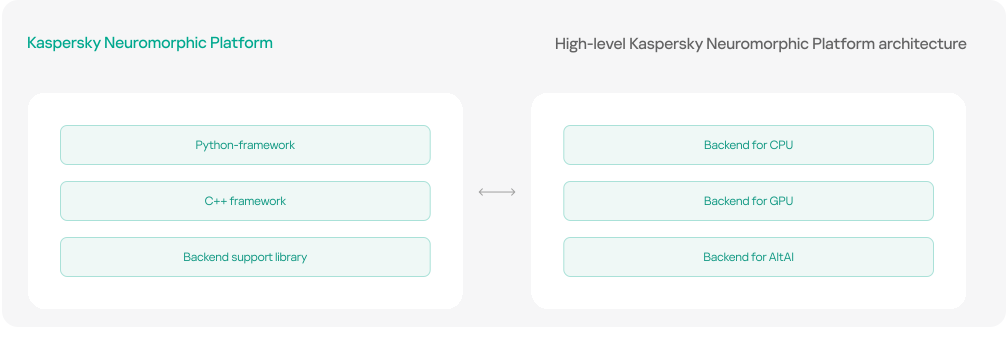
Along with CPU and GPU, KNP also supports the AltAI neuromorphic chip as a hardware backend.

The AltAI architecture uses a near-memory computing approach. This eliminates the excessive energy consumption typical of von Neumann architectures during data transfers between memory and computing core, thereby reducing overall power consumption.

The first - and current - generation of the AltAI chip (AltAI-1) supports inference of spiking neural networks.

The main structural unit of the AltAI-1 architecture is a core. A core combines a group of neurons and the memory to store their parameters. Within the core, the function of neurons is performed by a finite state machine that models their behavior.

AltAI-1 has a regular core structure arranged in a rectangular grid, where each core is directly connected to its four neighbors. A specially designed signal routing mechanism is used for transmitting spikes between neurons belonging to different cores. Accordingly, when a neuron function is performed, the potentials sent by neurons from other cores can be added to the potential of the neuron being modeled.

Currently, AltAI-1 prototypes have been released featuring 16 neurocores with 512 neurons per core.

The next generation of AltAI, scheduled for release in 2027, will have a number of important new features:

  • Online learning;
  • Programmable neuron model;
  • Programmable synaptic function;
  • Dynamic neural network structure.

This marks another step towards creating neuromorphic AI systems that are not only energy-efficient and fast but also adaptive.


Modular architecture
Main software components of KNP:
  • Python and C++ development frameworks;
  • GPU backend (training and inference);
  • AltAI neuromorphic chip backend (inference);
  • GPU backend;
  • AltAI software emulator (the "golden model").

Contact

To discuss collaboration opportunities, please email us at neuro@kaspersky.com,
or use the contact form below